Nara Travel Guide: Deer Park, Todai-ji & Japan's First Capital
Nara is Japan's first permanent capital — a UNESCO-listed treasure box of 1,300-year-old temples, Shinto shrines and 1,200 free-roaming deer who'll bow for a cracker. Just 45 minutes from Kyoto and an hour from Osaka, it's the easiest, most rewarding day trip in the Kansai region. Inside the 660-hectare Nara Park you can stand beneath the world's largest bronze Buddha at Todai-ji, walk a lantern-lined path to Kasuga Taisha and wander the Edo-era lanes of Naramachi — all on foot.
Explore Tweet World Travel Japan Small Group Tour or contact Tweet World Travel for a tailor-made travel experience.

History & Cultural Influence
Nara became Japan's first fixed capital (then called Heijo-kyo) in 710 AD, ushering in the Nara period — a golden age of Buddhism, court culture and the introduction of Chinese-style urban planning. Although the capital moved to Kyoto in 794, Nara remained the country's spiritual heartland. Eight of its temples, shrines and palace ruins are inscribed as UNESCO World Heritage Sites under the umbrella 'Historic Monuments of Ancient Nara'.
Quick facts:
Population: ~367,000
Founded: 710 AD as Heijo-kyo, Japan's first permanent capital
UNESCO Sites: 8 (Historic Monuments of Ancient Nara)
Signature landmarks: Todai-ji's Great Buddha, Nara Park deer, Kasuga Taisha, Kofuku-ji pagoda
Best for: easy day trips from Kyoto (45 min) or Osaka (60 min)
Top Attractions in Nara
Most of Nara's headline sights cluster around the 660-hectare Nara Park, so you can see the core in 6–8 hours on foot. Start by 8:30 a.m. to beat the day-tripper waves.
Todai-ji Temple & the Great Buddha — the world's largest bronze Buddha sits inside Daibutsuden, the largest wooden building on Earth. Adult entry ¥800 (2026).
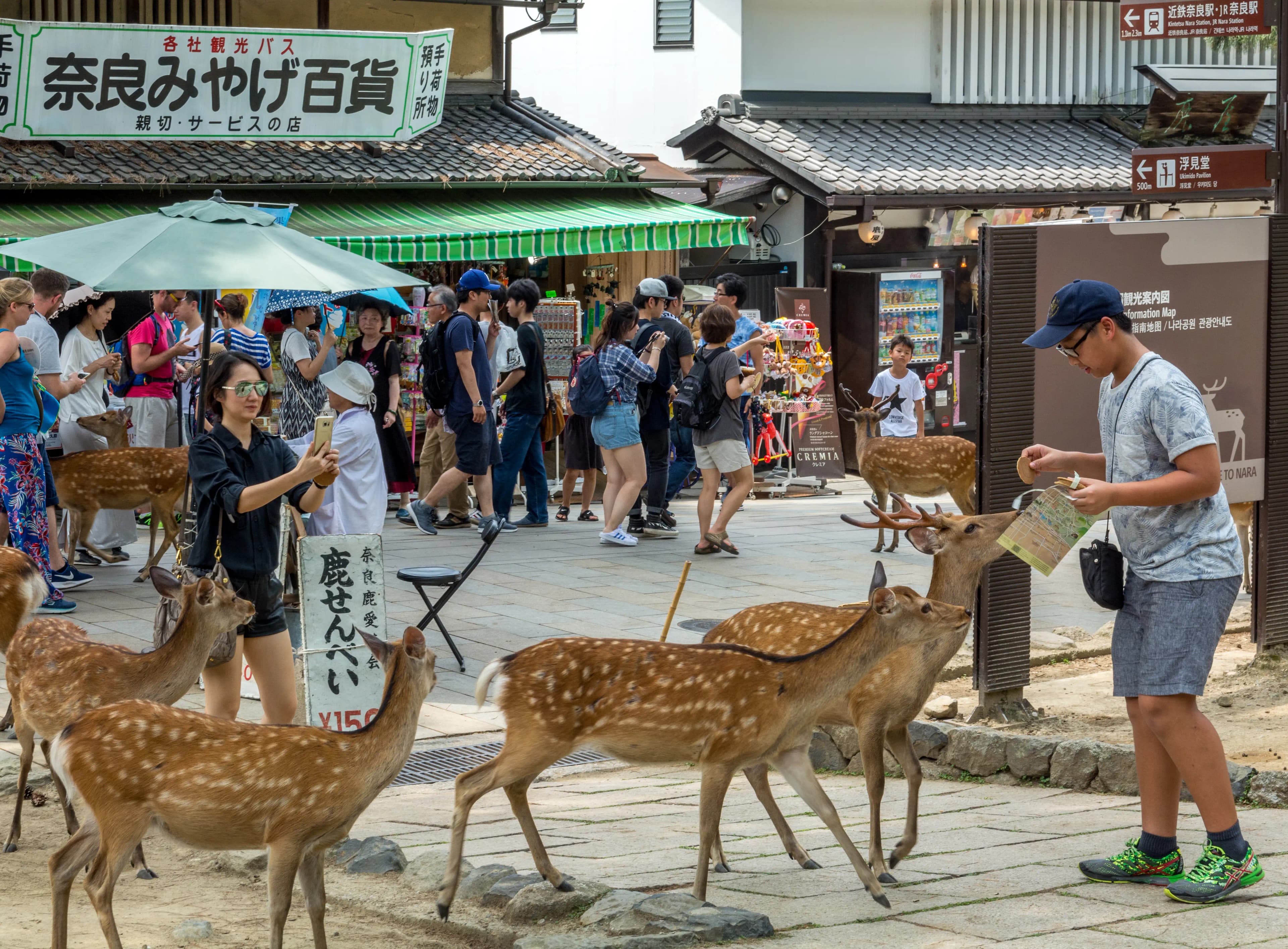
Nara Park & its 1,200 deer — Japan's most photographed wildlife park. The semi-wild sika deer bow for shika senbei (rice crackers, ¥200 per pack).
Kasuga Taisha Shrine — 3,000 stone and bronze lanterns line the cedar-forest path; founded in 768 AD and one of Nara's UNESCO gems.
Kofuku-ji Temple — a 50-metre five-story pagoda dominates the skyline; the National Treasure Museum holds priceless Buddhist sculpture.
Naramachi (Old Merchant Quarter) — Edo-period machiya lanes south of Sarusawa Pond, full of craft stores, sake brewers and small museums.
Toshodai-ji & Yakushi-ji Temples — two UNESCO temples in western Nara, founded in 759 AD and 680 AD respectively.
Mount Wakakusa — a grassy hill behind Nara Park with sweeping views of the city; an easy 30-minute climb at sunset.
Himuro Shrine — a small Shinto shrine dedicated to the god of ice, with stunning weeping cherry blossoms in spring.

Must-Try Dishes in Nara
Nara's food traditions go back over a thousand years and lean on mountain vegetables, pickles and refined Buddhist temple cuisine.
Kakinoha-zushi — sushi wrapped in persimmon leaves (the leaves preserve the fish and lend a subtle aroma); the must-try Nara specialty.
Narazuke (Nara pickles) — vegetables fermented in sake lees for months. Rich, complex and a brilliant accompaniment to rice.
Miwa somen — paper-thin white wheat noodles from nearby Miwa, served chilled with dipping sauce in summer.
Sakuramochi — pink rice cake filled with sweet red bean paste, wrapped in a salted cherry leaf; especially special during cherry-blossom season.
Hōba miso — sweet miso paste with mushrooms and onion, grilled over a magnolia leaf at the table.
Yakitori around Sanjo Street — Nara has a quiet but excellent yakitori scene, perfect after a day of temple-hopping.

Festivals & Local Celebrations
Nara's festival calendar is deeply tied to its temple and shrine heritage — many events are over 1,000 years old.
Omizutori / Shuni-e (1–14 March) — Nara's most famous festival at Todai-ji, where monks parade with giant flaming torches over Nigatsudo Hall.
Cherry Blossom Season (late March – early April) — hanami picnics at Nara Park, the Mount Yoshino slopes and the Himuro Shrine weeping sakura.
Nara Tōka-e (early August) — 20,000 candle lanterns illuminate Nara Park, Kasuga Taisha and the surrounding lanes.
Daimonji Bonfire (15 August) — a giant kanji-shaped fire is lit on Mount Takamado, visible across Nara, to send the spirits home at the close of Obon.
Shika no Tsunokiri (Deer Antler-Cutting, mid October) — a centuries-old ceremony at Roku-en park where the male deer's antlers are safely removed.
On-Matsuri (15–18 December) — Kasuga Wakamiya's 880-year-old festival with horseback archery, traditional dance and costumed parades.
What to Do in Nara
Nara is perfect for a slow, walk-led day. Pair the headline shrines with one experience or workshop.
Feed the bowing deer — buy a pack of shika senbei from a stall in Nara Park; tip the cracker slightly and the deer will bow.
Climb Mount Wakakusa for sunset — a 30-minute hike up the grassy slope behind Nara Park; one of the city's best free views.
Nara National Museum — Japan's deepest Buddhist art collection, ideal for a temple-supplement on rainy days.
Tea ceremony or calligraphy class — many machiya workshops in Naramachi run 60–90 minute sessions in English.
Naramachi walking tour — wander the Edo-period lanes between Sarusawa Pond and Gangō-ji, ducking into craft stores and sake breweries.
Day trip add-on to Horyu-ji — Japan's oldest wooden buildings (founded 607 AD) sit 20 minutes by train from Nara — easy half-day extension.

Shopping in Nara
Nara's shopping is craft-led: pickles, brushes, deer-shaped souvenirs and woodblock prints rather than big-mall fashion.
Higashimuki Shopping Street — covered arcade between Kintetsu Nara Station and Sanjo Street; the easiest one-stop for souvenirs and snacks.
Naramachi craft stores — washi paper, lacquerware, sake and indigo textiles; many are family-run for generations.
Nara Machi Museum Shop — curated local crafts, indigo dyes and ceramics with a small-batch feel.
Kintetsu Department Store — modern fashion, electronics and a depachika food hall; useful for souvenirs and last-minute essentials.
Nakatanidou (Sanjo Street) — the famously theatrical mochi-pounding shop; watch the high-speed pounding then taste the just-made yomogi mochi.
Local food markets — kakinoha-zushi, narazuke pickles and Yamato vegetables — perfect for edible souvenirs.
Weather in Nara: Best Time to Visit
Nara has four distinct seasons, each transforming the park. Spring and autumn are the most beautiful; midweek visits dodge the worst of the day-trip crowds.
Spring (Mar – May) — mild (10–20°C); cherry blossoms peak in early April at Nara Park and the Mount Yoshino slopes.
Summer (Jun – Aug) — hot, humid (30°C+); rainy tsuyu in June, then festival season — Nara Tōka-e's 20,000 candles in early August are unmissable.
Autumn (Sep – Nov) — comfortable (15–25°C); spectacular momiji foliage at Kasuga-Taisha forest and Tamukeyama Hachimangu in mid- to late November.
Winter (Dec – Feb) — mild compared to other Japanese cities (0–10°C), rare snowfall, very few day-trippers. Best season for quiet temple visits.
Cultural Etiquette in Nara
Nara is a deeply spiritual place. Respect the deer, the shrines and the local rhythms.
Feed deer carefully — only buy the official shika senbei crackers; never offer other food, and feed one deer at a time so they stay calm.
Bow at temple gates — slow, deliberate manners around shrines (and the deer) keep the atmosphere right.
Remove shoes — at temple inner halls, ryokan, machiya restaurants and tea houses; clean socks are appreciated.
Quiet voices in sacred spaces — Kasuga Taisha's cedar-lined paths are especially atmospheric in silence.
No trash bins, no problem — public bins are rare; carry your rubbish to your accommodation or station bin.
Chopsticks etiquette — never stick chopsticks upright in rice or pass food chopstick-to-chopstick (both resemble funeral rites).
Essential Travel Information
Getting around — Nara is built for walking. The core sights (Todai-ji, Kasuga Taisha, Kofuku-ji, Naramachi) sit within a 30-minute walking ring of Kintetsu Nara Station. Local Nara Kotsu buses connect the outer western temples (Toshodai-ji, Yakushi-ji) and Horyu-ji on the city loop. Cycling is the best way to cover more in a day — rentals are everywhere near Kintetsu Nara Station. From Kyoto, the Kintetsu Limited Express reaches Nara in 35 minutes; from Osaka-Namba the Kintetsu Express is 40 minutes; both are covered by major IC cards.
Money — International-friendly ATMs at 7-Eleven, Japan Post and FamilyMart. Cards work at hotels and bigger restaurants, but Naramachi craft shops, food stalls, shrines and Higashimuki vendors are often cash-only — carry ¥10,000–20,000 daily.
Connectivity — Wi-Fi is reliable around Kintetsu Nara Station and JR Nara; a pocket Wi-Fi or eSIM is recommended for full coverage in the temple grounds and outer trails.
Where to Stay in Nara
Most travellers visit Nara as a day trip, but staying overnight rewards you with quiet morning temple visits and an empty Nara Park.
Accommodation categories
Luxury & ryokan — JW Marriott Hotel Nara, Hoshino Resorts Nara Hotel (the historic 1909 grand hotel inside Nara Park), Nara Visitors Inn Sasayuri-ann.
Boutique & machiya — Naramachi Shitateya, Sasayuri-ann's restored farmhouses, Mikasa Pavilion.
Mid-range hotels — Mercure Hotel Nara, Hotel Asyl Nara, Nara Hotel — convenient and walkable to the park.
Budget — Guesthouse Nara Backpackers, Sakuraya Hostel, K's House Nara — clean, design-led dorms close to the station.
Best neighbourhoods for first-timers:
Around Kintetsu Nara Station — the most convenient base; 10-minute walk to Nara Park and most attractions.
Naramachi — old-Edo lanes south of the park, perfect for a slow, atmospheric stay.
JR Nara area — slightly further west; cheaper lodging and a convenient shinkansen connection via Kyoto Station.
Frequently Asked Questions
Here are the most common questions first-time travellers ask about Nara — quick answers to help plan your trip.
How many days do you need in Nara?
One day is enough to see the headline sights of Nara Park — Todai-ji, Kasuga Taisha, Kofuku-ji and Naramachi can all be done in 6 to 8 hours on foot. Add a second day if you want to include Horyu-ji, the western temples (Toshodai-ji and Yakushi-ji) or Mount Yoshino.
Is Nara better as a day trip from Kyoto or Osaka?
Both work brilliantly — Kyoto is closer (35–45 minutes by Kintetsu Limited Express) and is the more popular choice. Osaka-Namba is only 40 minutes by Kintetsu Express. Most travellers base in Kyoto for two nights and slot Nara in as a day trip.
Do the deer in Nara really bow?
Yes — the semi-wild sika deer of Nara Park have learnt to bow for shika senbei rice crackers. Tip the cracker slightly back toward yourself and most deer will return a quick bow. The crackers are sold at park stalls and vending machines for ¥200 per pack; only buy the official ones, and feed deer one at a time so they stay calm.
What's the best time to visit Nara?
Spring (late March to early April) for cherry blossoms and mid-to-late November for autumn foliage are the most photogenic seasons. Winter (December to February) has the fewest crowds and rare snowfall over Todai-ji. Always start by 8:30 a.m. for calm deer and crowd-free temple halls.
How much does it cost to enter Todai-ji?
Adult entry to Todai-ji's Daibutsuden (Great Buddha Hall) is ¥800 as of 2026. The temple is open daily from around 7:30 a.m. (winter 8 a.m.) until 5:30 p.m. Nara Park itself is free, and feeding the deer costs ¥200 per pack of crackers.
Our Best-Selling Tours
Follow Us